
Icynene Attic Insulation in Ventura: A Homeowner’s Guide
Icynene open-cell spray foam costs roughly two to three times more per square foot than blown-in fiberglass, and it insulates to a lower R-value per inch than closed-cell foam. On paper, that looks like a bad trade. But there’s one performance characteristic where Icynene genuinely outclasses every other material in a Ventura attic: it seals the building envelope and manages vapor at the same time. Whether that matters for your house depends on how your attic is built, and that’s the conversation most homeowners never get to have before they sign a contract.
What makes Icynene different from other spray foams?
Icynene is an open-cell spray foam. It expands to roughly a hundred times its liquid volume, cures soft and spongy, and lands around R-3.7 per inch. Closed-cell foam, by contrast, cures rigid at roughly R-6.5 to R-7 per inch and acts as its own vapor barrier. Those are different tools for different jobs, and in Ventura’s climate the difference matters more than the R-value gap suggests.
Open-cell foam is vapor-permeable. Moisture that gets into the assembly can move through it and dry toward the conditioned space rather than getting trapped against the roof deck. Closed-cell foam is a vapor retarder at typical thicknesses, so if it’s installed on the underside of a roof deck over a damp substrate, it seals that moisture in. In a marine-influenced climate where humidity swings with the weather, drying potential is not a small detail.
Icynene also differs from generic open-cell foams in how it’s formulated and installed. It’s one of two spray foam brands we work with (Demilec is the other), and both are recognized by building scientists and energy auditors as benchmarks for air sealing. When you’re paying a spray foam premium, you’re paying for a product that’s been tested in the field and specified by name on commercial jobs, not a commodity drum.
Where Icynene is the right call in a Ventura attic
Icynene earns its price in specific attic configurations. If your home matches one of these, open-cell spray foam is often the technically correct choice rather than a sales upgrade:
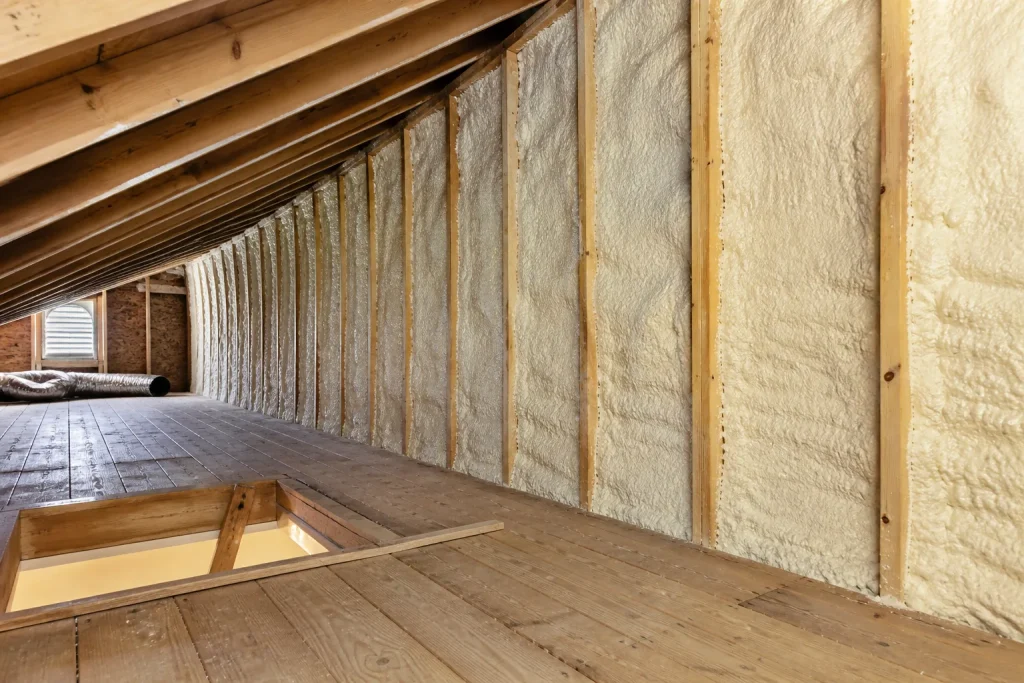
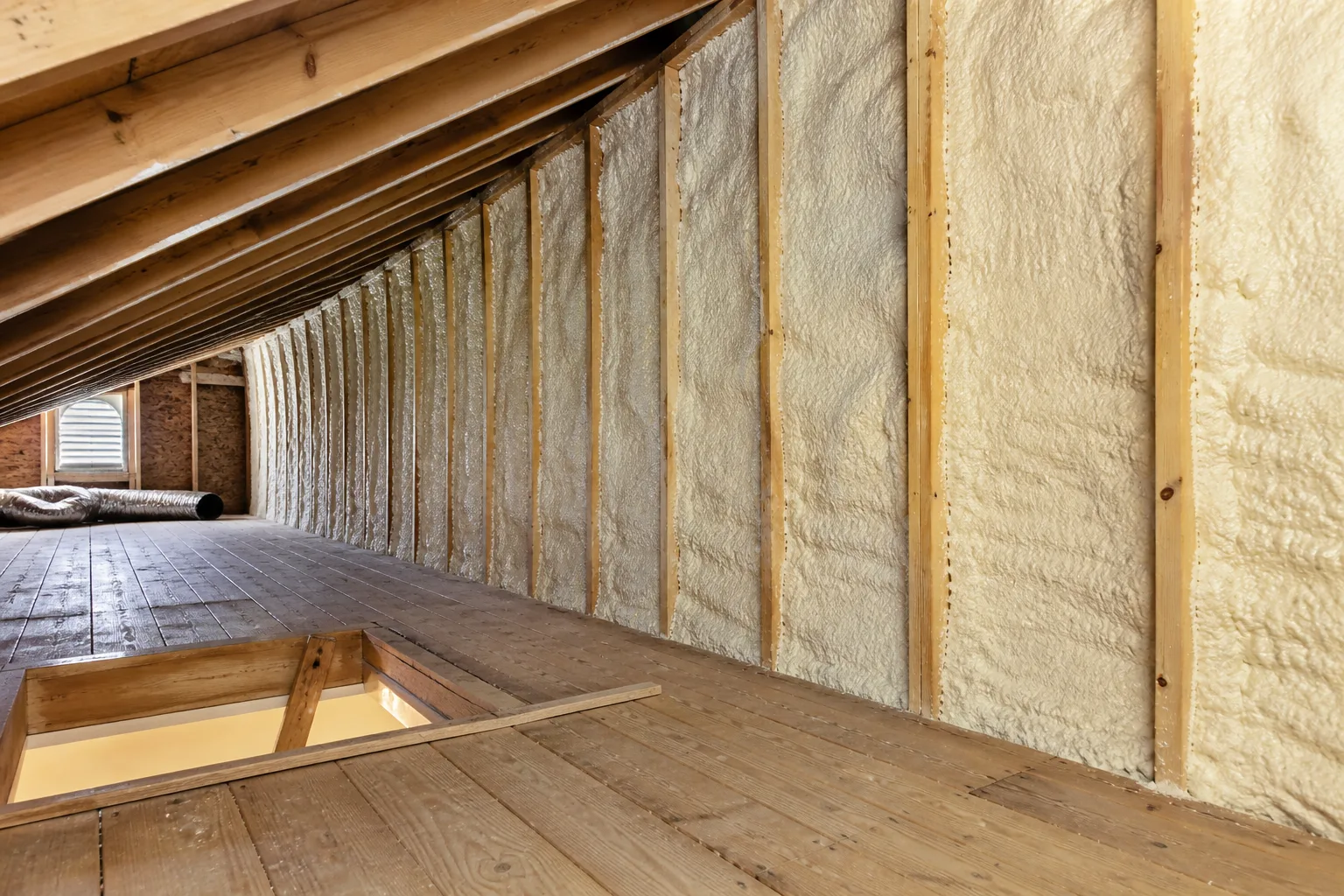
- Unvented conditioned attics. When HVAC equipment or ductwork sits in the attic and you’re bringing that space inside the thermal envelope, you need an air barrier and a vapor strategy at the roof line. Icynene handles both in one pass.
- Complex rooflines. Hip-and-valley roofs, dormers, and cathedral ceilings create cavities that batts can’t fill completely. Spray foam conforms to the geometry and closes the gaps where air leaks live.
- Ductwork in the attic plane. Ducts running through an unconditioned attic lose energy before the air reaches your rooms. Sealing the attic with open-cell foam brings the ducts inside the envelope, and that’s usually where homeowners feel the difference fastest.
- Older homes with irregular framing. If previous remodels left you with odd stud spacing or half-finished framing, foam adapts where rigid materials can’t.
The common thread: Icynene is at its best when air sealing and vapor management matter as much as raw R-value. That’s most of the interesting attics in Ventura.
Where Icynene is not the right call
We’d rather talk you out of spray foam when it doesn’t fit than sell you a product that underperforms. In our experience, open-cell foam is the wrong answer in three common situations:
- Vented attic floors. If your attic is vented and the insulation goes on the floor, blown-in cellulose or fiberglass does the job at a fraction of the cost. There’s no reason to spray the roofline if you’re not conditioning the attic.
- Tight R-value budgets. If you need to hit a specific R-value and budget is the constraint, blown-in gets you there for less money. Icynene gives you better air sealing, not more R per dollar.
- Assemblies where permeability is a liability. If the roof deck is already failing or has active moisture problems, foam can hide the problem rather than fix it. We check the deck before recommending foam, and we walk away from installs that need a roofing fix first.
If none of those describes your situation, spray foam is probably worth pricing. If one does, ask your contractor to explain why they’re still recommending it.
Icynene cost vs. blown fiberglass vs. closed-cell in Ventura
Typical installed price ranges for a Ventura attic run roughly $3.50 to $5.50 per square foot for Icynene open-cell, $1.50 to $2.50 for blown-in fiberglass or cellulose, and $5.50 to $8.50 for closed-cell foam. These are estimates; the written quote after an attic inspection sets the final number.
| Material | Typical installed cost (per sq ft) | R-value per inch | Vapor profile | Best for |
|---|---|---|---|---|
| Icynene open-cell foam | $3.50 – $5.50 | ~R-3.7 | Vapor-permeable | Unvented attics, complex roofs, ductwork in attic |
| Blown-in fiberglass or cellulose | $1.50 – $2.50 | ~R-2.5 to R-3.5 | Vapor-permeable | Vented attic floors, budget-driven retrofits |
| Closed-cell foam | $5.50 – $8.50 | ~R-6.5 to R-7 | Vapor retarder | High-R needs, assemblies needing a barrier |
On payback: open-cell foam tends to pencil out over several years in homes where air leakage and duct losses are the main problem, because the air sealing does most of the work. It rarely pencils out as a straight R-value purchase. If you’re comparing on R per dollar alone, blown-in wins. If you’re comparing on comfort and HVAC strain, Icynene often wins.
If your attic needs a material decision, our spray foam insulation page outlines spray foam options in more depth, and our attic insulation page covers the rest of the material line for comparison.
What to check before an Icynene install
Icynene is only as good as the assembly it goes into. Before anyone sprays, three things need to be verified:
- Roof deck condition. Any active leak, soft sheathing, or past water damage needs to be resolved first. Spray foam over a wet deck traps the moisture and hides the evidence.
- Ventilation strategy. Icynene on the roofline usually means the attic is being brought inside the envelope, and the existing soffit and ridge vents have to be closed off or reworked. If a contractor sprays without addressing ventilation, ask why.
- Permits and code. California’s residential energy code sets requirements that vary by assembly and climate zone, and the local building department has the final say. We check the requirement during the estimate and pull the permit before the install. Ask any contractor to confirm they do the same.
If the attic has any of these issues unresolved, the right move is to fix them first and spray later. That’s not a delay; that’s the job.
When to call a pro
Spray foam is not a DIY product. The chemicals are applied under pressure with specific temperature and mixing requirements, and a bad mix produces foam that never cures properly, off-gasses, or fails to adhere. There’s no way to patch an improperly applied section without removing it. If your attic needs air sealing, spray foam, or just a straight answer on which material fits, call a specialist. We carry eight brands across fiberglass, mineral wool, spray foam, and cellulose, so the recommendation follows your attic rather than whatever’s on hand. Our technicians have up to 8 years of experience, and insulation is all we do.
Related services in Ventura
If you’re comparing Icynene against other approaches, our Ventura Insulation team handles attic insulation, spray foam, and blown-in installation as a single-trade specialist. Read more on the attic and spray foam pages, then book an estimate and we’ll walk the attic with you.
What happens when you call
- 1
A real person answersNo phone trees – you reach a local pro.
- 2
You get an upfront price rangeHonest numbers before anyone is dispatched.
- 3
A background-checked tech heads outLicensed & insured, dispatched right away.
- 4
You approve before work beginsNothing starts until you say go.
The Bottom Line
Icynene open-cell foam is the right material for Ventura attics that are being brought inside the thermal envelope: unvented roofs, complex framing, ductwork in the attic plane. It’s the wrong material for vented attic floors and R-value-driven retrofits, where blown-in fiberglass, cellulose, or a GreenFiber or Owens Corning product gets you the same comfort for less. Closed-cell foam earns its price on high-R assemblies and vapor-retarder requirements. The decision starts with the attic, not the product. If you’re in Ventura and need help deciding, Ventura Insulation offers free estimates with a written quote and upfront pricing. Call (866) 942-5951. We answer 24/7. Fast dispatch from 7am to 7pm, Sunday through Friday.
Frequently Asked Questions
Typical installed cost runs $3.50 to $5.50 per square foot for open-cell Icynene in a Ventura attic, which means a typical 1,200 square foot attic lands in the $4,200 to $6,600 range depending on depth and prep work. Those are estimates; the written quote after inspection sets the final price. Call (866) 942-5951 for an exact quote, and estimates are free.
Neither is better in general. Icynene is vapor-permeable and better suited to assemblies that need drying potential, like an unvented roof deck over wood sheathing in a humid climate. Closed-cell is denser, has higher R-value per inch, and provides its own vapor barrier, which is better for high-R assemblies and specific code-driven needs. The right choice depends on your attic.
Yes, but it’s expensive. Cured open-cell foam has to be physically scraped or ground off the substrate, which is why getting the install right the first time matters more than the brand on the drum. Ask your contractor to confirm they test spray parameters before the full install, and ask for references specific to attics similar to yours.
Often yes. California’s residential energy code sets requirements that vary by assembly and climate, and your local building department has the final say. We check the requirement during the estimate and pull the permit before scheduling the install. Confirm the same with any contractor you hire, and if they can’t explain the permit requirement, that’s a signal.
Written by the team at Ventura Insulation.
Need Insulation Help?
Call Ventura Insulation - licensed & insured, with free written estimates in Ventura.
(866) 942-5951